What to Look For in a Card Shop Before You Visit
There is a shop twenty minutes away. You have seen the pin on the map, you have read four reviews, and you still have no idea whether it is worth the drive.
That is a normal place to be. A map listing is built to tell you a business exists and roughly where. It is not built to tell you whether a particular shop has the thing you collect, prices it in a way you can check, or treats a newer collector like someone worth talking to.
This article is the decision process. What you can work out before you leave, how to tell whether a shop fits what you collect, what to notice in the first few minutes inside, and how to decide whether to go back.
What Google Maps can tell you about a card shop
Probably more than you are using. Worth knowing what is actually there before deciding it is not enough.
A business can fill in its own listing with hours, phone number, website, photos and videos, a set of categories, product listings, services, and answers to common questions. Owners can also respond to reviews and post updates. If a shop has done that work, the listing can tell you a fair amount.
So the first move is to actually read it rather than glance at the star rating.
Categories. A shop picks a primary category and can add more. This is the broadest signal of what kind of business it is: trading card store, hobby shop, comic book store, game store. Several of those can describe the same shop, and which ones an owner picked tells you something about how they see themselves.
Photos. The most useful part of most listings, and the most ignored. Look past the exterior shot. Interior photos show you case layout, how much wall space goes to sealed product versus singles, whether there are tables for play, and how busy the place looks. Check the dates. A listing full of photos from four years ago is telling you something different from one updated last month.
Products and services. Some shops list these, some do not. When they are there, they are specific and useful.
Questions and answers. Owners can post their own common questions, and customers can ask. This is where you sometimes find the answer to things like whether they buy collections or run events.
Reviews, read properly. The star average is the least informative number on the page. What matters is what people mention. Reviews that name specific things, a set someone was looking for, a trade that went well, how a first-time visitor was treated, tell you far more than a wall of five-word ratings.
Now the limits, stated honestly.
Two things are worth keeping in mind. A listing is only as complete as the owner chose to make it, so a sparse profile can mean a quiet shop or simply an owner who has never updated it. And the category and attribute system is built for businesses in general, not for collecting. There is no standard listing field for whether a shop stocks Japanese Pokémon product, carries back issues, runs Commander night, or buys collections. Those are the questions you actually have, and the listing format was not designed around them.
That is not a flaw in the map. It is just the wrong tool for the last mile of the decision, which is what the rest of this article covers.
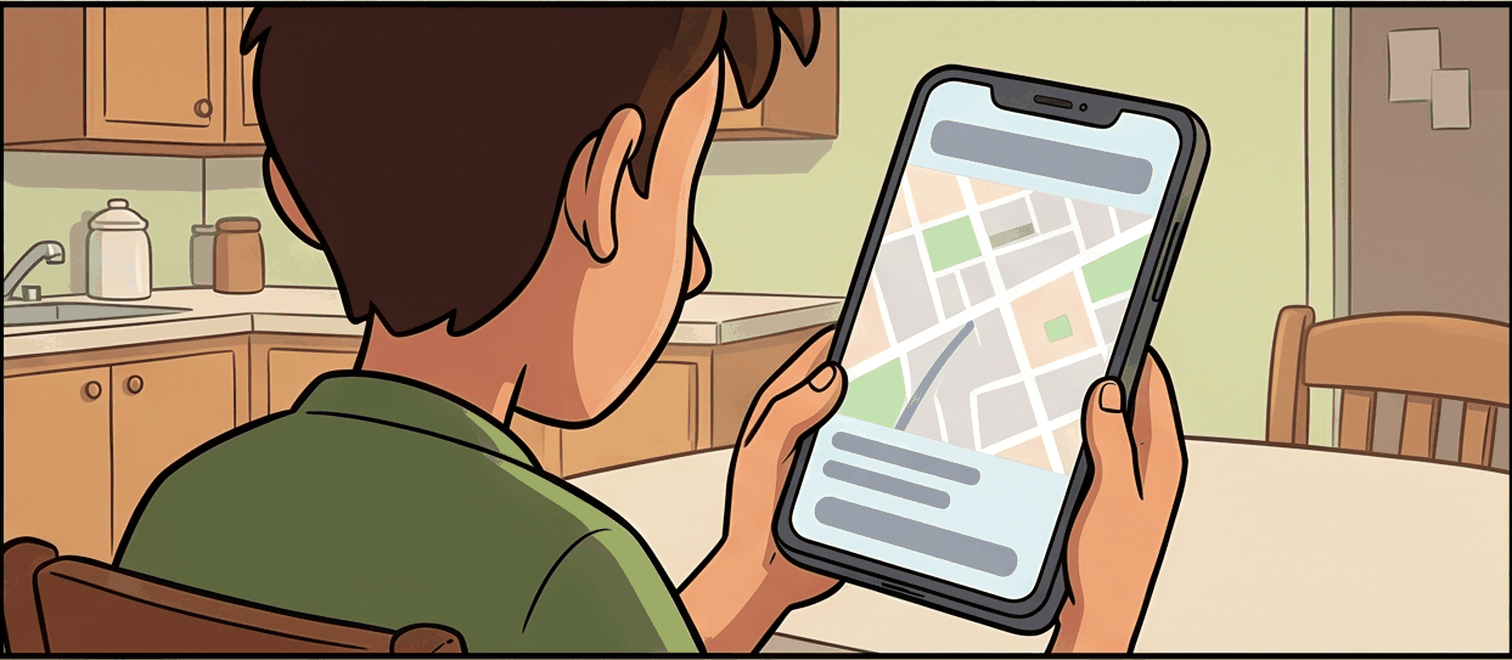
Before you go: five things worth checking
Five minutes on your phone before you spend an hour on the road.
1. Current hours, including event nights. Posted hours and event schedules drift. If the listing shows a website or social page, check there too, since event nights often live on a social post rather than in the hours field.
2. Recent interior photos. Not the storefront. You want to see cases, shelves and tables. If every photo is old or every photo is the sign, you are going in with less information than you think.
3. Whether reviews mention what you care about. Search the reviews for your own words. If you collect vintage baseball and nobody has ever mentioned vintage, that is worth noting before you drive.
4. Whether the shop shows current stock anywhere. A website, an online store, or an active social account posting new arrivals tells you what is moving through the shop right now, which no static listing can.
5. One phone call. This is the one people skip and it is the one that saves the trip. Ask one specific question: do you carry singles for this set, do you buy collections, is league night still running on Thursdays. A short call answers in ninety seconds what an hour of browsing listings will not.
If you are still working out which shops are near you, CollectorsHaul lists card, comic and hobby shops by location and lets you filter them by what they carry, including Pokémon, sports cards, comics, Magic, Yu-Gi-Oh, One Piece, Warhammer and video games. It is a way to start from what you collect rather than from a pin on a map. What it will not tell you is what is in the case today, which is still a phone call.
Does the shop fit what you collect?
This is the question underneath all the others, and it can matter more than a shop’s overall rating.
A shop can be well run, fairly priced and friendly, and still be the wrong shop for you. That is not a red flag. It is a fit problem, and it is worth separating the two, because a shop that is wrong for you may be exactly right for the person standing next to you.
Here is what fit looks like in practice.
If you collect Pokémon. Look for whether they carry singles at all or only sealed product, since those are close to different businesses. Check whether Japanese product sits alongside English, which matters if you collect it and is a signal of how deep the shop goes if you do not. See whether graded slabs are in the case, and whether the singles on display go beyond the newest set.
If you collect sports cards. Check whether more than one manufacturer is represented. See whether there is anything older than the current season, since plenty of shops stock modern only and that is a legitimate choice rather than a failing. If you are thinking about selling, find out whether they buy collections or only take consignment, and whether they handle the sport you have.
If you play or collect Magic. Singles depth is the thing to look at. A shop with a deep singles wall is running a different operation from one with a rack of sealed boosters. Notice whether the stock leans toward Commander, Standard or older formats, and whether events run, because an active play space usually comes with a singles inventory that turns over.
If you collect comics. Find out whether they carry back issues or new releases only. Look at how issues are stored, and whether there is a separation between graded or key issues and the bulk boxes. A shop with a long wall of new releases and three short boxes in the corner is a new-release shop, which is useful to know before you go hunting for something from 1987.
If none of the shops near you fit what you collect, that is worth knowing early too. It changes the question from which shop to visit to whether a shop visit is the right move at all, and the answer might be a card show instead.
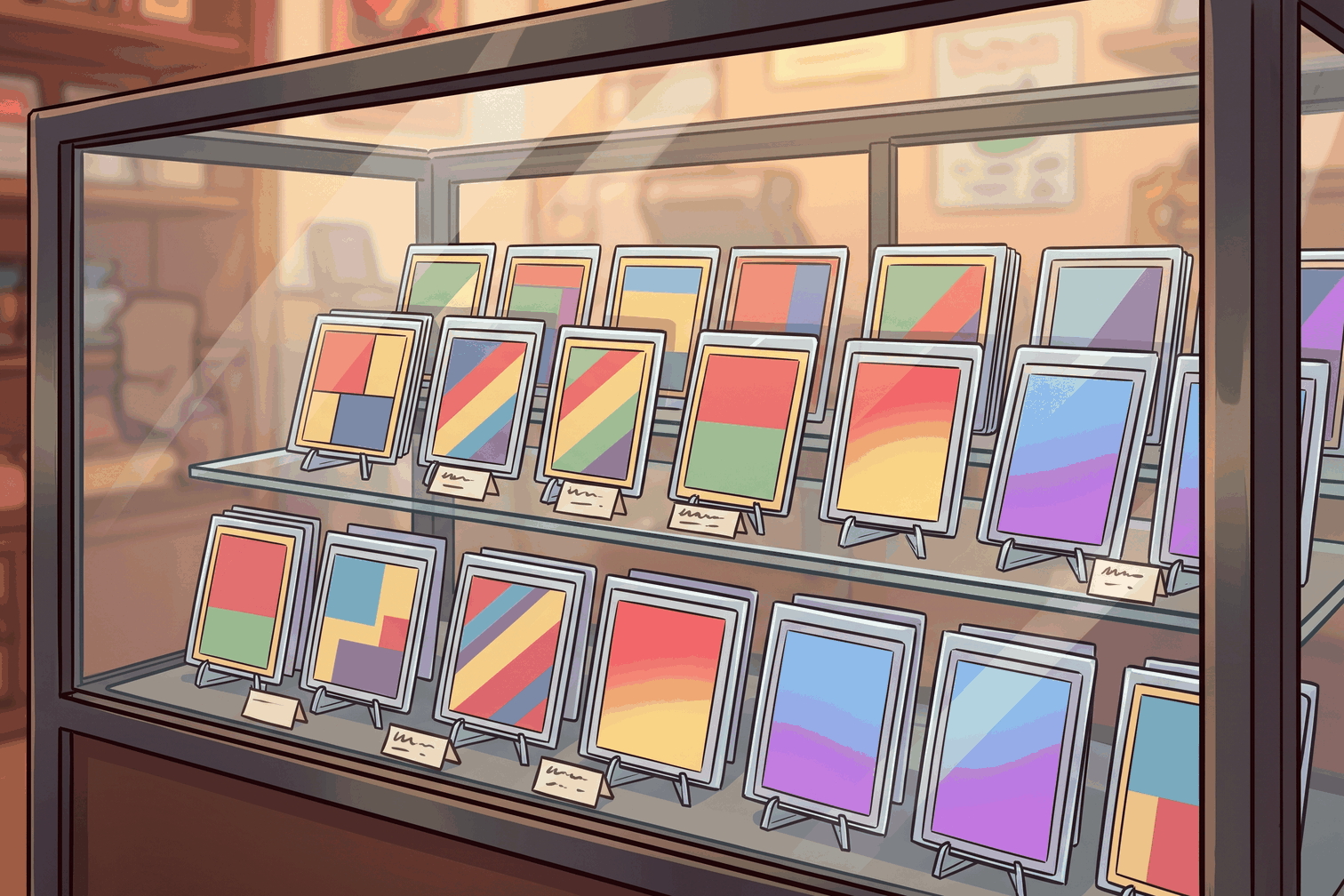
Green flags: signs of a good card shop
Things worth noticing, and what each one suggests.
Organized cases and labeled sections. A shop where you can find things without asking has usually put thought into how people actually browse.
Singles that go deeper than the newest release. A singles inventory takes work to build and maintain. Depth there suggests a shop that is in it beyond chasing whatever released last week.
A range of price points. Dollar bins and a locked premium case in the same room means the shop has room for a kid with ten dollars and a collector with a budget. That tells you who they are willing to serve.
Pricing you can check. Prices on singles referenced to a visible source, whether that is a market site, recent sales, or a stated policy, means you can verify what you are being asked to pay. Not every shop does this and its absence is not damning, but its presence is a genuinely good sign.
A play space that is actually in use. Tables with people at them, an events calendar on the wall with dates that have not passed, product set aside for an upcoming release. A shop that hosts things has a reason for people to return, and shops with regulars tend to have inventory that moves.
Staff talking to someone who is not buying anything. This one is easy to miss and tells you a lot. A shop where someone is answering a question with no sale attached is a shop you can ask a question in.
Condition handled carefully. Sleeves, toploaders, cards handled by the edges, comics bagged and boarded. How a shop treats its own stock is a reasonable preview of how it will treat yours.
Red flags: when to be cautious
None of these mean a shop is dishonest. They mean slow down and ask another question.
Not being given a reasonable chance to assess condition before buying is the one that should stop you. Condition is most of the value on a single, so you need some way to judge it. That does not mean a shop has to hand you everything. Keeping higher-value cards in a case, having staff handle them, asking you to use a mat or gloves, or showing you a card without letting you flip through a box unsupervised are all normal and sensible policies, and none of them are a warning sign. What matters is whether you are given a way to look. A shop that will take a card out, turn it over under decent light and let you look at the corners is doing the right thing. A shop that will not let you assess it at all before money changes hands is asking you to buy blind.
Prices with no reference point anywhere, on singles or slabs, make it hard to tell whether you are getting a fair deal, and a shop that cannot explain how it arrived at a number is asking you to take it on faith.
Pressure to decide now is worth noticing in either direction, whether you are buying or selling. A card that is genuinely worth what is being asked will still be worth it after you have looked something up.
Dismissiveness toward a beginner tells you what the room is like. So does heavy investment language, where the conversation is about what a card will be worth later rather than what it is. There is nothing wrong with caring about value, but a shop that leads with it every time is selling something other than cards.
Reviews are worth a second look rather than a first impression. A cluster of very short five-star reviews posted in the same short window, repeated complaints about the same specific thing, or an owner arguing with reviewers all give you something to weigh.
And if something feels off and you cannot name why, you are allowed to leave. Nothing obligates you to buy.
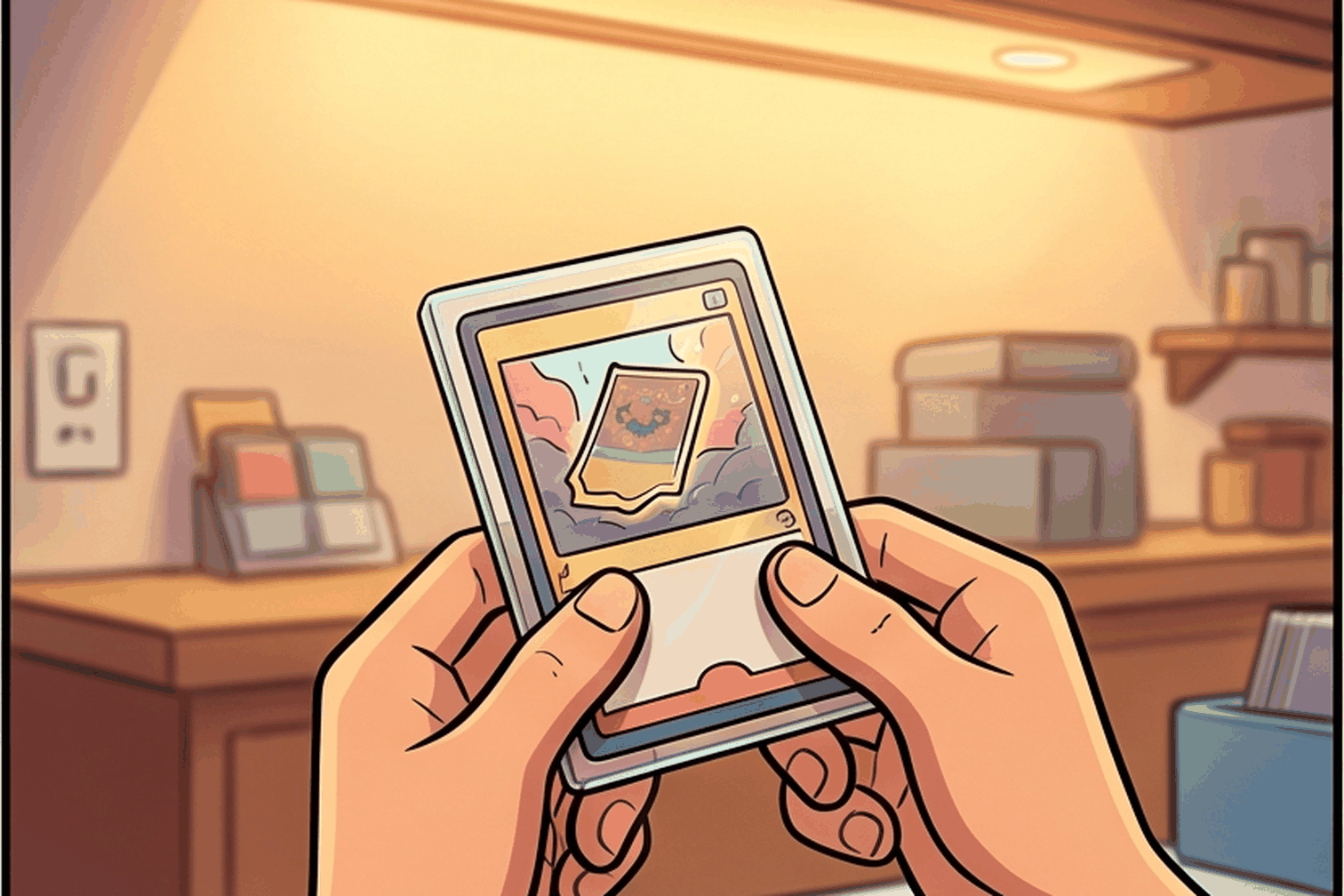
The first five minutes inside
You will know more in five minutes than an hour of research gave you.
Walk the room before you talk to anyone. Look at what takes up the most space, because that is what the shop is actually built around. Sealed walls, singles cases, play tables, comics racks, supplies. The layout is the shop telling you what it is.
Look in the cases without opening anything. Check whether prices are marked. Find the cheapest thing in the room and the most expensive, because the distance between them tells you the range of customer this shop expects.
Notice who else is in there and what they are doing. Browsing, playing, talking to staff, selling something at the counter.
Then say hello and ask one question. The answer, and how it is given, is most of what you came for.
If it is the wrong shop, that is a useful outcome. You spent five minutes finding out instead of planning a Saturday around it.
Visiting a card shop for the first time
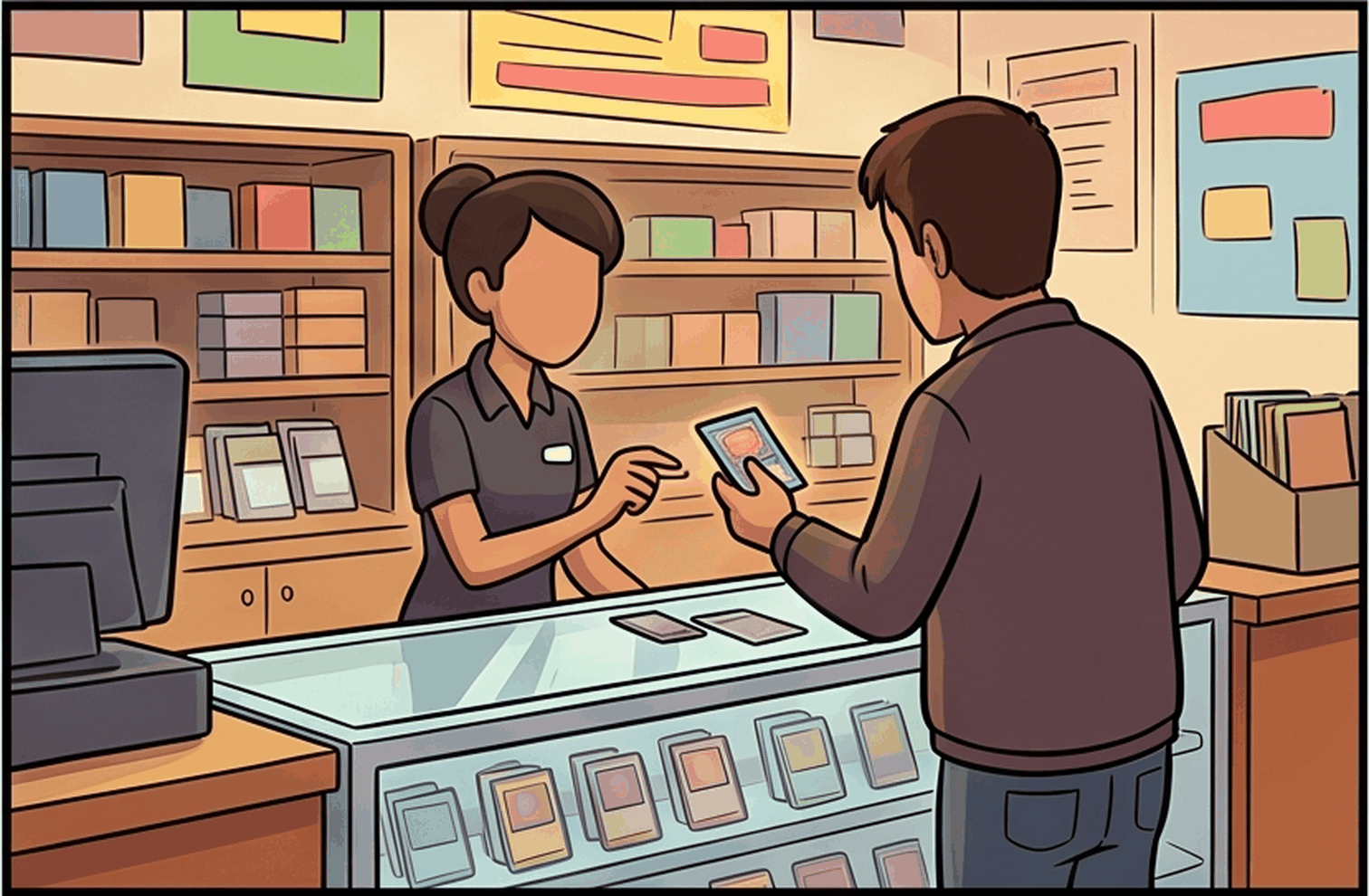
Worth saying plainly: walking into a shop without knowing much is normal, and you do not need to prove anything to anyone in there.
The worry is usually about asking something that reveals you are new. The fix is to ask questions that do not require you to know anything in the first place. Any of these work on a first visit:
- “What do you carry the most of?”
- “Do you have singles, or mostly sealed?”
- “I’m looking for something from [set or year]. Is that something you’d have?”
- “Do you run any events?”
- “Do you buy collections?”
- “I’m just getting back into this. Where would you start?”
All six are ordinary questions a shop hears regularly. None of them require you to know a set name, a grading scale or a price.
Two practical things. Ask before handling anything, especially anything in a case or a binder, since that is the norm everywhere and it is the fastest way to get treated as someone who knows the room. And if you are bringing cards in to sell, it helps to have them sorted and to know roughly what you have before you walk in. We wrote a separate guide on preparing a collection before visiting a card shop, and if you are not sure what your cards are worth in the first place, start with whether an old collection is actually worth anything.
Think about which kind of visit suits you. An event night puts other players in the room, which some people find easier because the attention is not on them and there are people to talk to. A quiet weekday puts staff attention squarely on you, which is better if you want to browse slowly or ask a few questions without a crowd around. Neither is the right answer for everyone. Our guide to finding a local TCG community covers how event nights run if that is the route you want.
What about comic shops?
Most of the above applies, with a few differences worth knowing.
The split that matters is back issues versus new releases. A shop built around new-release day has a long wall of current issues and a rhythm that peaks midweek. A back-issue shop has long boxes, and the question is how they are organized and whether anyone has sorted them recently. Plenty of shops do both, unevenly.
Look at how issues are stored. Bagged and boarded, upright, out of direct light, with keys and graded books kept separate from bulk. Storage is condition, and condition is most of the value.
Grading works differently on the comics side. The names you will see on comic slabs are not the same ones you see on cards, so a shop that handles card grading submissions may not handle comics, and vice versa. Worth asking rather than assuming.
And ask about pull lists. A shop that will hold your titles each month is offering the comics equivalent of a reason to come back, which is the same signal an events calendar gives you on the card side.
When a shop is worth visiting again
One visit tells you what a shop has. A second tells you what it is like.
New arrivals are the easiest thing to notice. If the singles have changed, the case has cards in it you had not seen, or there is product out that arrived since your last visit, that is a shop giving you a reason to keep coming back. Read the opposite carefully, though. A display that looks the same does not by itself tell you stock is not moving. Cases get restocked with similar inventory, the good stuff can sell and be replaced with more of the same, and plenty of shops rotate the back room without rearranging the front. If you want to know whether things move, ask what came in recently.
Whether anyone remembers you matters more than it sounds. Not as flattery. A shop where staff recognize returning customers is usually a shop with regulars, and regulars are what make a shop hold things for you, tell you when something comes in, and give you a straight answer about a card.
Think about whether you left with something you actually wanted rather than something you settled for. A shop that only ever has the second thing is a shop you will stop visiting on your own eventually.
And notice whether you can ask a question without it turning into a sale. That is the difference between a shop you buy from and a shop you belong to, and only the second kind is worth building a habit around.
Frequently asked questions
How do I know if a card shop’s prices are fair?
Check before you buy. Look up recent completed sales for the specific card, in the specific condition, on your phone while you are standing there. A shop price can sit above the lowest online price and still be reasonable, since you are getting the card today, in hand, with the chance to inspect it and nothing to ship. What you are testing for is whether the price is in a range you can account for, not whether it matches the cheapest listing on the internet.
What should I ask when I walk into a card shop for the first time?
Something that does not require you to know anything. “What do you carry the most of” works in any shop and gets you a useful answer. So does “do you have singles or mostly sealed”, “do you run events”, and “I’m getting back into this, where would you start”. You are not being tested.
Is a local card shop better than buying online?
They solve different problems. A shop lets you inspect condition yourself, walk out with the card the same day, avoid shipping on small purchases, and ask a question of a person. Online gives you selection and price comparison a single shop cannot match. Using both is a reasonable approach, choosing per purchase based on what that purchase needs.
Do card shops buy single cards or only whole collections?
It varies by shop, and it is one of the better things to settle with a phone call. Some buy singles over a value threshold, some prefer collections, some only take consignment, and some only buy in categories they can resell locally. Ask before you load the car.
What if the only shop near me does not carry what I collect?
That is worth finding out early rather than after a drive. A shop that is wrong for you is not a bad shop. If nothing nearby fits, a card show is worth considering, since a show puts many sellers in one room and a wider range of inventory than a single storefront carries.
How can I tell if a shop is good before I drive there?
You cannot be certain, but you can get close. Read the listing properly rather than glancing at the star rating, look at recent interior photos, search the reviews for the things you specifically care about, check whether the shop shows current stock anywhere online, and call with one specific question. That combination will not make you certain, but it can reduce the chance of an unnecessary trip.
Before you drive out
The process is short: read the listing properly, check the five things, work out whether the shop fits what you collect, then give it five honest minutes once you are inside.
A shop that does not fit is not a wasted trip if you learned that quickly. And a shop that does fit is worth more than one visit, because the second one is where you find out what it is actually like.
If you are still deciding where to start, you can browse shops by city and state on CollectorsHaul and narrow them by what they carry.
← Back to Blog