How to Prepare Your Collection Before Visiting a Card Shop
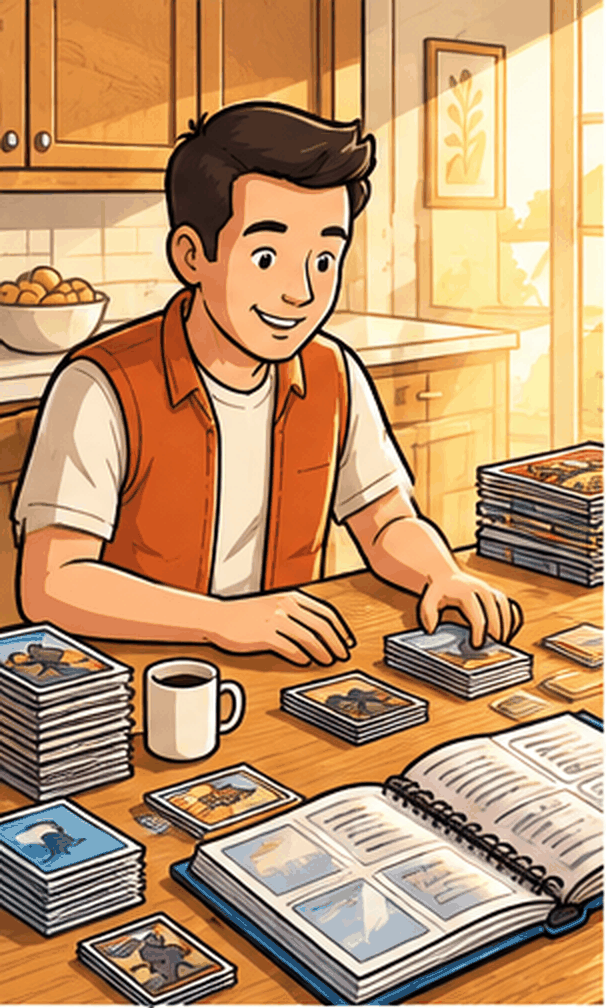
Picture the shoebox. Someone carries in an unsorted box of cards, sets it on the counter, and waits. The owner has twenty minutes, a line forming, and no fast way to tell whether the box holds three hundred dollars of playable singles or three hundred commons. So the offer comes in low and safe. That is not malice. That is what an unknown quantity is worth to someone buying it sight mostly unseen.
Here is the part most people never hear: an hour at your kitchen table usually moves the offer more than any negotiating tactic will. Prep is not about being polite to the shop owner. Prep is what determines the size of the number you get quoted. If you are thinking about selling cards to a local card shop, this is the work that pays for itself before you leave the house.
If you have not picked a shop yet, start with our guide on where to sell sports cards, Pokémon cards, and comics locally, then come back here to get ready.
Why Prep Changes the Offer You Get
Shops price risk. That is the mechanic behind every offer you will get across a counter.
Looking at a sorted, documented collection, a shop can assess quickly and price the cards on what they actually are. Looking at a loose pile, it has to price for everything it cannot see: condition problems buried in the middle, the hours of sorting it will absorb, the chance the good stuff was already pulled. Every one of those unknowns comes out of the offer, because the shop is the one carrying them.
Flip that around and the advice writes itself. Every unknown you remove before you arrive is one the shop no longer has to discount for. Cheap to evaluate means priced closer to what it is worth.
Step 1: Sort Before You Sleeve
Sort by sport or game first, then by set and year inside each pile. Baseball with baseball, Pokémon with Pokémon, 1989 with 1989.
Do not sort alphabetically by player or character. It feels organized and it is useless here. Shops buy along set and year lines because that is how value clusters and how price guides are built. A stack of 1986 Fleer basketball tells a buyer something immediately. The same cards spread alphabetically tell them nothing until they redo your work.
Knowing how to organize cards to sell is mostly this one decision. Get the sort axis right and everything after it goes faster.
Step 2: Separate the Bulk From the Singles
Bulk is the commons, duplicates, and low-demand cards that make up most of the weight of most collections. Not junk, but not priced card by card either.
Do card shops buy bulk cards? Most do, priced per thousand rather than per card. That distinction explains the mistake that costs people the most money: leaving good cards mixed in. A card sitting in a five-thousand-card box gets bought as part of a five-thousand-card box. Nobody is flipping through to rescue it.
Pull anything with real demand out first. Rookies of players people still talk about, chase cards, holos, short prints, anything numbered, anything from a set collectors chase. Those get evaluated on their own terms. Everything else goes in bulk boxes, sorted by sport or game and roughly by era.
Step 3: Only Sleeve What Deserves Sleeving
Sleeving is protection, not presentation. Match the protection to the card.
Penny sleeves belong on singles with genuine value, which is most of what came out of your Step 2 pile. Toploaders or one-touch holders belong on your best cards, where a corner ding would move the price. Bulk needs neither and travels fine in row boxes.
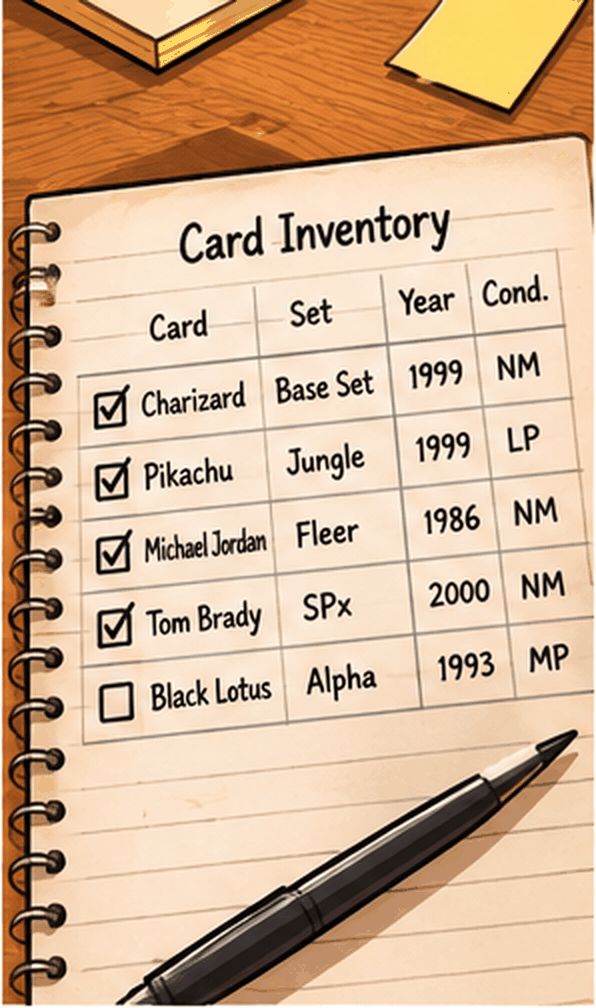
Over-protecting bulk is a double loss. You spend money on supplies you will not recover in the offer, and you slow the shop down, because someone now has to pull four thousand commons out of sleeves to count them. Speed is on your side in a buy session.
Step 4: Spend Fifteen Minutes on Your Top Ten Cards
You do not need to price your whole collection. You need to know roughly what your ten best cards are worth, because the offer will hinge on them.
Look up sold prices, not asking prices. On eBay, filter to sold and completed listings rather than what is sitting unsold at somebody’s dream number. For auction comps, 130point pulls recent sale data in an easy format to scan. Check the last few months instead of the single highest sale you can find, and match condition honestly. A raw near-mint copy is not comparable to a graded gem.
The point is not to walk in with a price you intend to enforce. It is to know whether an offer is in the neighborhood or nowhere near it.
How Much Do Card Shops Actually Pay?
Most local shops buy below current market value, and there is a real reason for it. The shop takes on the risk of holding the card, uncertainty about its condition and how it would grade, the chance demand cools before it sells, and the cost of eventually reselling it. Every one of those is a cost the shop absorbs the moment it hands you cash.
With that understood: for desirable singles, sellers commonly see offers somewhere around 40 to 70 percent of recent sold prices. That range is what people tend to encounter, not a rule any shop is bound by. It runs higher on cards that move fast and lower on cards that will sit.
What pushes an offer up is demand the shop can see: current players, popular sets, cards that sell the same week they hit the case. What pushes it down is condition uncertainty, thin local demand, and anything the shop expects to hold for a year. A card that is hot in your area is worth more to a shop in your area, which is an underrated reason to sell locally at all.
Bulk sits outside this entirely. It is priced per thousand, and the number depends on the sport or game, the era, and how sorted it already is. Do not try to convert a bulk quote into a percentage.
Knowing the range is what lets you recognize a fair offer instead of guessing at one.
Step 5: Bring a Simple Inventory List
Not a spreadsheet with four thousand rows. Nobody is reading that, including you.
One page. Your top cards, with set, year, player or character, and rough condition. Handwritten is fine. If you have recent sold prices from Step 4, add a column, marked as what you saw rather than what you want.
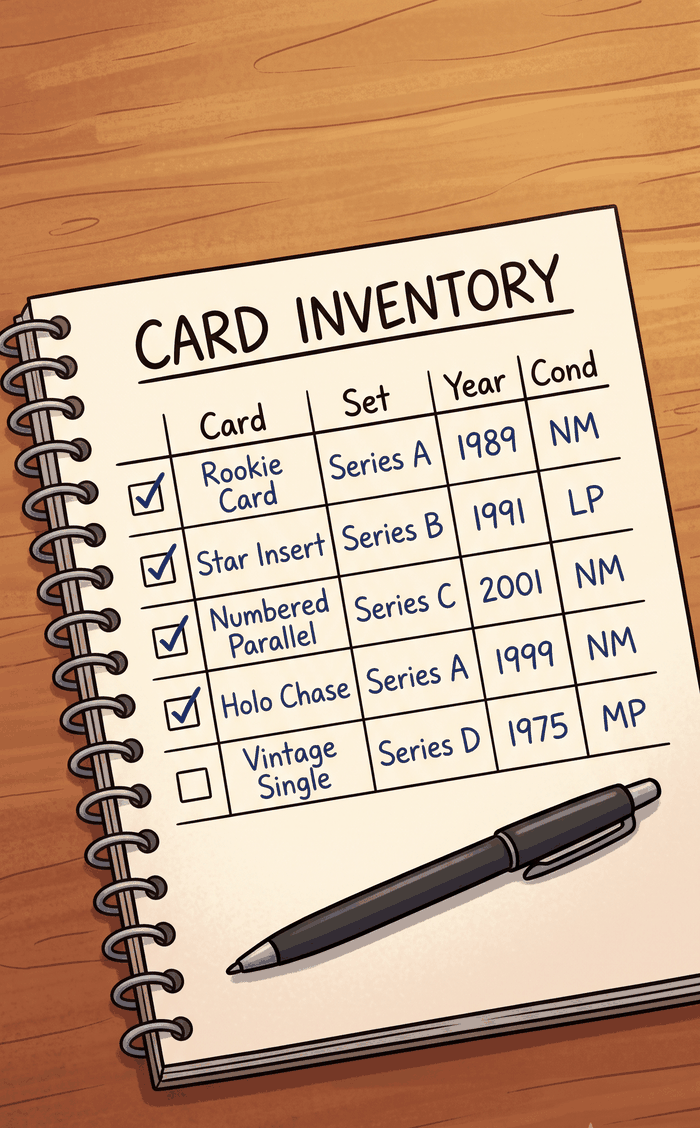
Two things happen when you hand that over. The visit speeds up, because the buyer works down your list instead of discovering your collection card by card. And you get something to check the offer against, so you can see which cards it did or did not account for.
Step 6: Decide What You Actually Want Before You Walk In
Cash, store credit, consignment, or just an appraisal. Pick before you arrive.
The counter is a bad place to make this decision. There is a number in front of you, someone is waiting on an answer, and store credit usually comes in higher than cash, which is tempting even if credit is not what you came for.
| What you get | Typical value received | How long it takes | Best when | |
|---|---|---|---|---|
| Cash | Money, same visit | Lowest of the four | Immediate | You want to be done, or you need the money now |
| Trade credit | Store credit toward inventory | Higher than cash, often noticeably | Immediate | You were going to spend it at a shop anyway |
| Consignment | A cut after the card sells | Highest, minus the shop’s percentage | Weeks to months | You have high-value cards and can wait |
| Appraisal only | Information | No money changes hands | One visit | You are not sure you want to sell yet |
This is also where the card shop versus eBay question gets settled. eBay reaches more buyers and often produces a higher gross number on a single strong card. It also costs you fees, shipping, packing time, and return risk, and none of it happens in an afternoon. For a whole collection, especially one with a lot of mid-value and bulk, local is usually the sane call. For one high-end card you are willing to babysit for two weeks, the math can go the other way.
If You Have Comics, a Few Things Change
Same logic, different handling rules.
Bag and board anything with value. Never rubber bands, never tape, and never tape on a book for any reason. Do not clean, press, or repair anything yourself. Amateur pressing is visible to anyone who handles books for a living, and it turns a correctable problem into a permanent one.
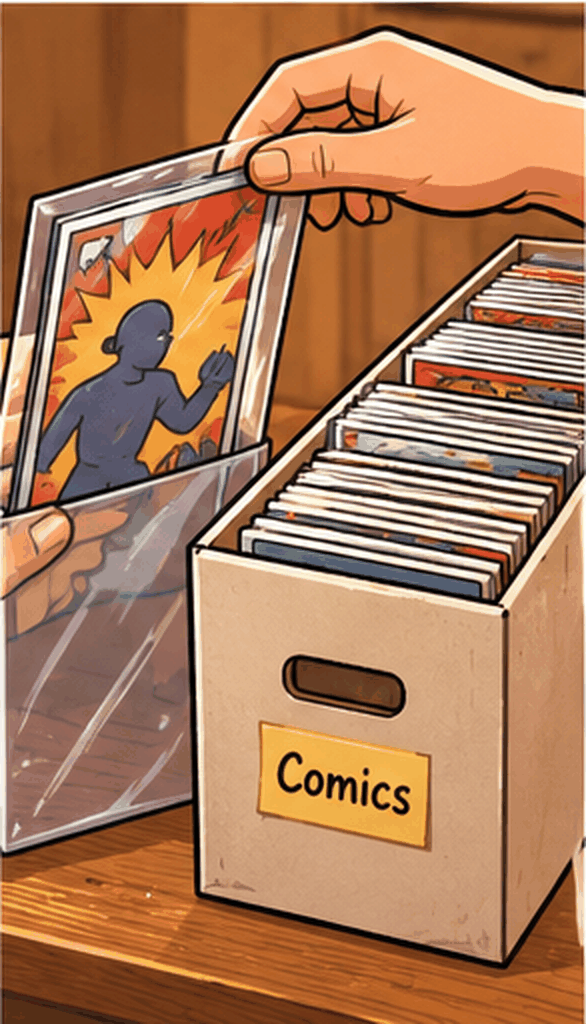
Separate keys from runs. First appearances, first issues, and notable variants get evaluated individually. Runs get sold as runs, so keep them in order and together, since a complete run is worth more than the same books scattered. Long boxes of readers get treated like bulk cards: sorted by title, priced as a group.
If you are selling comics to a comic shop rather than a card shop, call ahead. Plenty of stores buy one and not the other.
What Not to Do
- Do not show up at close. You want the buyer unhurried, and thirty minutes before lockup is the opposite of that.
- Do not arrive without knowing whether the shop buys your category. Some do cards only, some comics only, some skip vintage entirely.
- Do not lead with a price you found on a listing. Asking prices are not sale prices, and opening with one signals you have not checked comps.
- Do not bring the collection in a trash bag. It damages cards in transit and undoes the sorting you just did.
- Do not expect an offer on ten thousand cards in one visit. A rushed offer on a big pile is a low offer.
What to Expect Once You Are There
The sequence at most shops looks the same. A quick triage, where the buyer flips through to see what categories and eras they are dealing with. A closer look at your top cards, which is where your Step 4 work starts earning. Then an offer, usually split into singles and bulk. Then your choice.
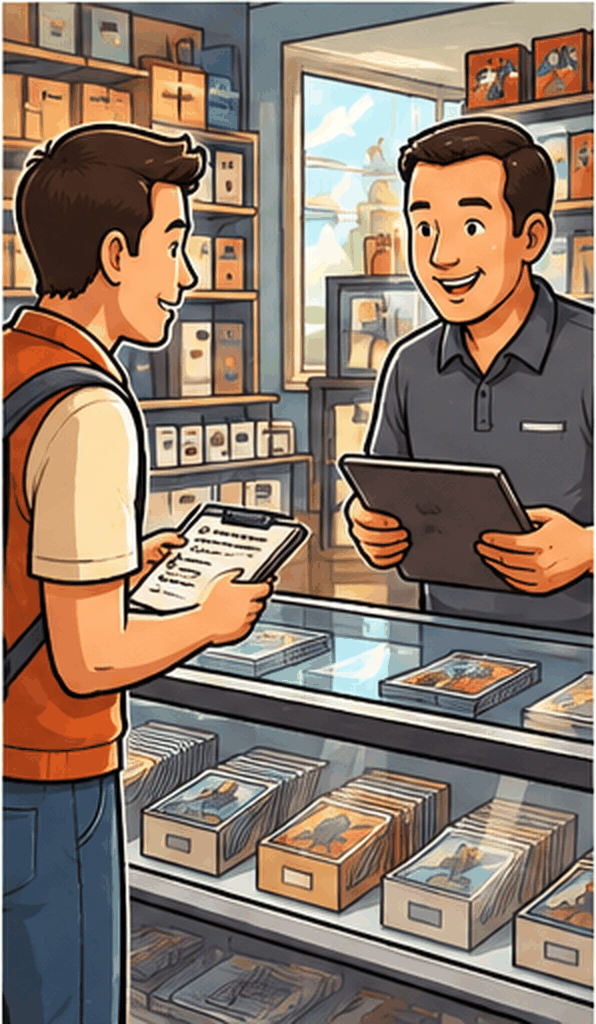
A few things worth knowing in advance. Larger collections often need a day, so a shop may ask to keep the boxes overnight or have you come back. Cash and credit numbers usually differ, and you can ask for both. And walking out to think about it is completely fine. Any shop worth selling to expects it.
Frequently Asked Questions
How much do card shops pay for cards?
Most local card shops pay roughly 40 to 70 percent of recent sold prices for desirable singles, with bulk priced separately per thousand rather than as a percentage. Offers land higher for cards in current demand and lower for cards with condition questions or thin local interest. The discount covers the shop’s inventory risk, condition uncertainty, and the cost of reselling.
Do card shops buy bulk?
Most do, priced per thousand rather than per card. Sort it by sport or game and pull anything valuable out first, because cards left in bulk get bought as bulk.
Should I get cards graded before selling them to a shop?
Usually not, if selling is the goal. Grading costs money and takes weeks, and the value bump only clears the cost on a narrow band of cards that are both high value and likely to grade very well. Most shops price raw cards fine and factor grading potential into the offer themselves.
Is a card shop or eBay better for selling?
eBay tends to produce a higher gross number on individual strong cards but costs you fees, shipping, packing time, and dispute risk, and it takes days or weeks. A shop pays less per card and pays today. For whole collections, particularly ones with significant bulk, local usually nets out better once your time is counted.
Do I need an appointment?
Not usually for a small stack, but call ahead for anything large. Buy sessions take a staff member off the floor, and a shop that knows you are coming can have someone ready.
Will a shop buy a collection they cannot resell locally?
Sometimes, at a lower number, because they would be buying it to move online or to another dealer. This is why matching the shop to your collection matters. A store built around modern Pokémon is not the best home for 1970s baseball, and the offer will say so.
Ready to Go?
Once your collection is sorted, sleeved, priced, and listed, the only thing left is picking the right shop. Use the CollectorsHaul directory to find card and comic shops near you, check what each one specializes in before you load up the car, and go get a real offer on work you have already done.
Still deciding whether a shop is the right move at all? Read where to sell sports cards, Pokémon cards, and comics locally for how shops compare to the other options.
← Back to Blog