How to Spot Fake Pokémon Cards Before You Buy
Almost every guide to spotting fake Pokémon cards has the same problem. The tests all require the card to be in your hands.
Hold it up to a light. Feel the card stock. Check the kerning under a loupe. All useful, all real, and none of them available to you at the moment you actually decide to spend the money, which is usually while looking at three photos and a seller’s username.
That gap is where people get burned. So this guide is built in two stages: what you can actually evaluate before you buy, and what to check the moment the card arrives. It also covers Magic, One Piece, and Lorcana, because the tells are not identical across games.
One thing worth saying up front. Nothing here proves a card is real. These checks catch fakes. A card that passes all of them has cleared a reasonable bar, not earned a certificate.
Before You Buy: The Signals That Come Before the Card
Most of the damage happens here, and almost none of it requires expertise.
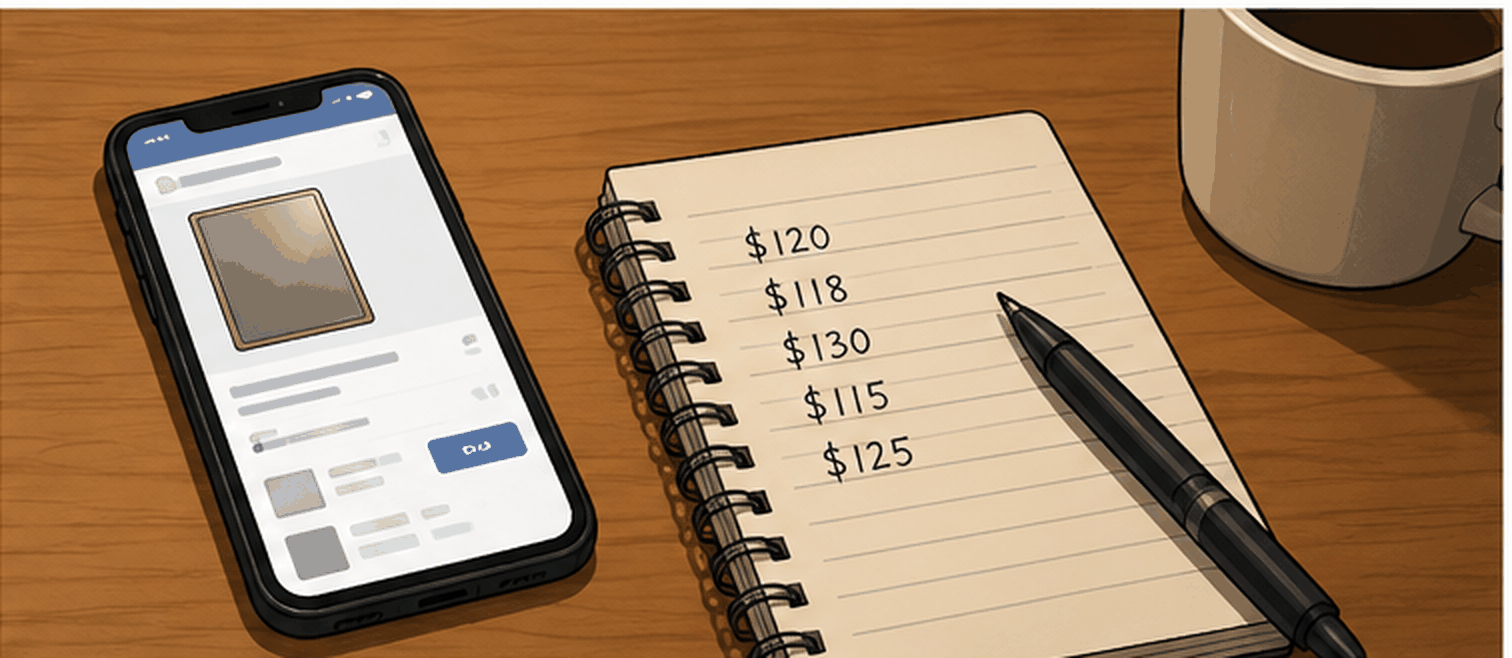
Start with the price. A price meaningfully below what the card actually sells for is one of the strongest warning signs you can spot before buying. Not a slight discount, which is normal. A number that makes you feel lucky. Counterfeiters price to move, and a legitimate seller with a genuine valuable card has no reason to badly undercut a market they can look up as easily as you can. Before you evaluate anything else, check recent sold prices so you know what normal looks like.
Read the listing language carefully. Phrases like “authentic reproduction,” “flash cards,” “proxy,” or “custom” are not ambiguous. They are the seller telling you, in terms designed to survive a marketplace policy review, that the card is not official. Sealed product advertised as loaded with chase cards is another one. If a box promises far more hits than a real box contains, the box is not real.
Demand real photos. Stock images, a single low-resolution front shot, or images obviously lifted from a database are all reasons to ask for more. Request the actual card, front and back, in natural light, plus an angled shot showing the edge. A seller with a genuine card will send them. A seller who stalls or sends the same stock image again has answered the question.
Look at what else they sell. A seller with fifteen high-value chase cards from different eras, all attractively priced, all listed the same week, is not a collector clearing out a closet.
None of this is technical, and all of it happens before you spend anything.
When It Arrives: The Feel Test
The first physical check is not visual at all. It is tactile, and it catches a surprising share of fakes immediately.
Genuine cards have a specific stiffness and a slightly textured back. Counterfeits fail in one of two directions. Some feel papery and flimsy, closer to construction paper, and bend too easily. Others feel slick and plasticky, like a card from a fresh deck of playing cards, sometimes with a faint sheen on the back that should not be there.
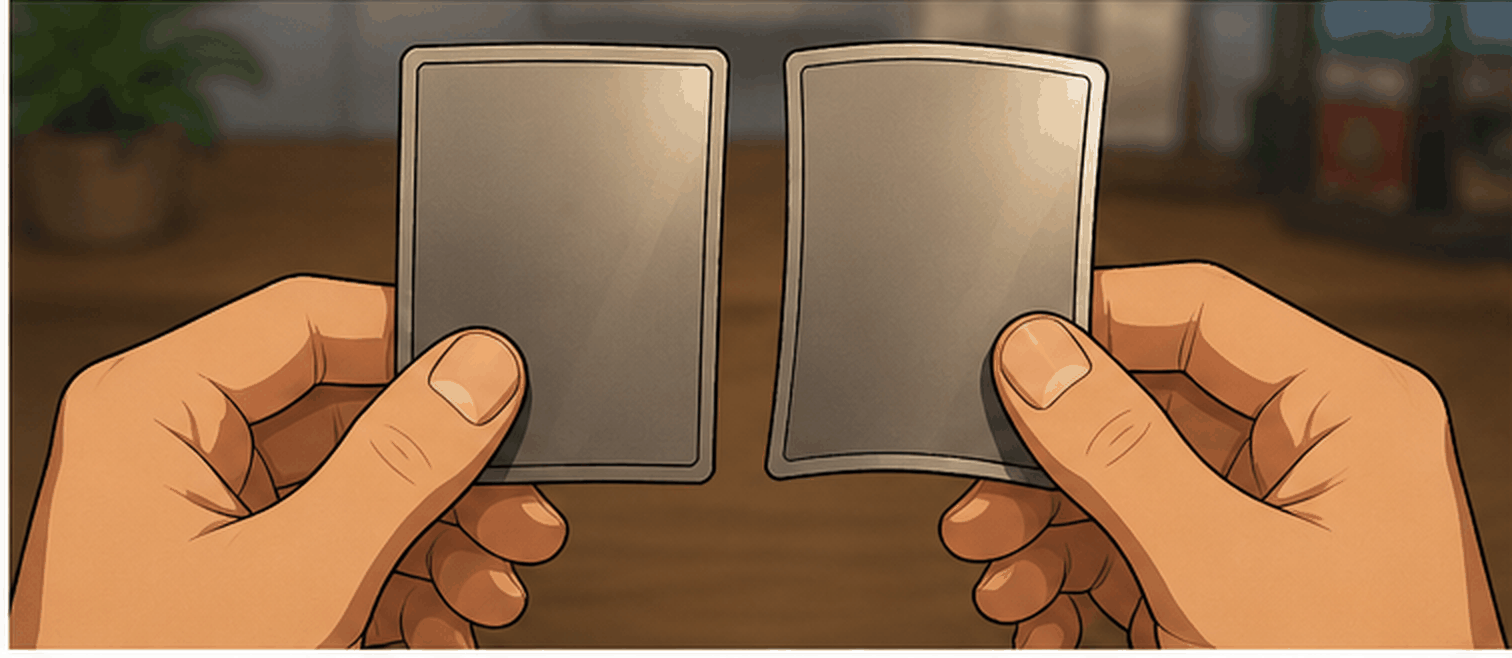
Compare against something you know is real. A common or a basic energy card from a pack you opened yourself works perfectly, and keeping one in your desk as a reference is the single most useful habit in this article.
While you have both in hand, check size and cut. Fakes are sometimes very slightly smaller. Stack the suspect card on the known-good one, then reverse the order and check again. Look for clean square edges rather than rough or uneven ones. Size alone is not proof, since jumbo and box-topper cards legitimately exist, but a mismatch on a standard card is worth taking seriously.
The Card Back
The back is the most useful surface on the card, because it is identical across millions of cards. You do not need to know anything about the specific card to know what the back should look like.
Colour is the common failure. Counterfeit backs frequently run too light, washed out, or noticeably purple rather than the correct blue. Sometimes they run too dark and muddy instead. Either way, side by side against a genuine card the difference is usually obvious even to someone who has never looked closely before.
Print quality is the other. Look at the swirl pattern and the fine detail. Fakes often show blurring, a faint fabric-like or woven texture running through the print, or visible bleed-through of the front artwork on thin stock. Also check centering. Genuine cards are not perfectly centered every time, but consistently shifted borders are a flag.
Font, Spelling, and the Details Counterfeiters Miss
This is where cheap fakes fall apart fastest, and it costs nothing to check.
Spelling errors. Misspelled names, transposed letters, and mangled rules text are common on counterfeits. Genuine error cards do exist, but they are rare and documented. A card with several typos is not a collectible error.
The accent on Pokémon. Counterfeits frequently drop the acute accent on the é, most often in the small copyright text at the bottom of the card. An otherwise convincing fake will give itself away on this one detail.
Kerning and typeface. Kerning is the spacing between letters. On fakes it is often too wide and inconsistent, with some passages looking nearly normal and others visibly gappy. The typeface itself is frequently subtly wrong.
Energy and set symbols. These are often misshapen, off-center within their orb, incorrectly sized, or missing outright.
Implausible numbers. Absurdly high HP or damage values are a favorite of counterfeiters targeting kids. Power creep is real, but four-digit HP is not.
If you are unsure whether a detail is wrong, look the card up in the official Pokémon TCG card database or a reference site like PkmnCards and compare directly.
Texture and Holo on Chase Cards
Modern chase cards are hard to fake well, which makes them useful to check.
Genuine textured cards have physical texture in the card surface itself, which is why the holo catches light unevenly as you tilt it. Counterfeits often print the texture pattern flat onto the card. It looks like texture in a photo and feels like nothing under your thumb, and the holo reflects too evenly because there is no relief to break it up.
Fake holos also tend to look simple and flat, and sometimes carry an odd brownish or orange cast. Tilt the card under a light and watch how the shine moves. Real holo has depth and pattern. Fake holo mostly just shines.
Some fakes are not cards at all but stickers, usually slightly undersized with a loud holo covering the entire face.
The Light Test, and What It Actually Tells You
Genuine cards are a sandwich. There is an opaque dark inner layer between the front and back, and cheap counterfeits printed on single or double-layer stock do not have it.
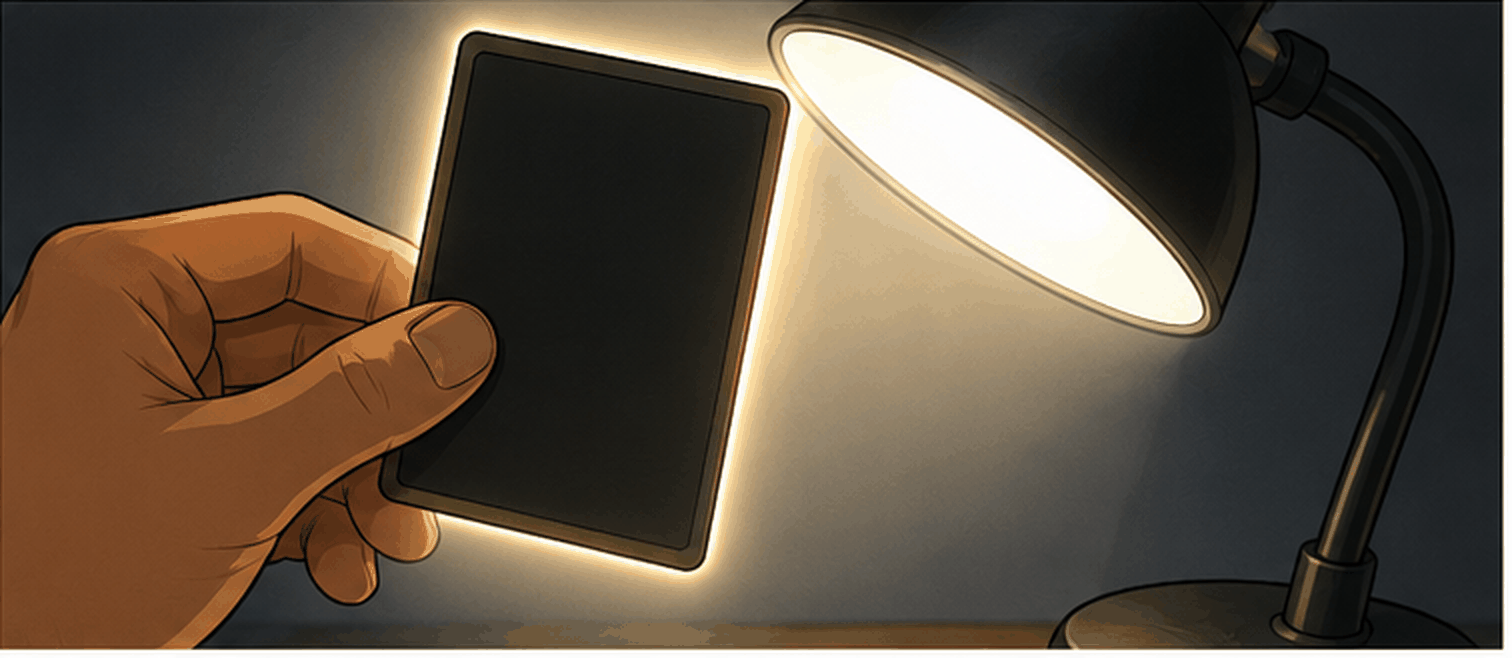
The non-destructive version is the light test. Hold the card against a bright light, a lamp or a phone flashlight, and look through it. A genuine card blocks nearly all of it. A card printed on thin stock without the dark core lets light pass through and often shows the artwork glowing from the other side.
You will also see this called the rip test, where the card is torn to expose the layer directly. That exposes the card’s internal construction directly, but it destroys the card, so it belongs at the very end of the list and only on something you have already concluded is worthless.
Here is what the light test does not do. It tells you about card construction, not identity. It cannot tell you whether a real card body has been altered, trimmed, or misrepresented as something rarer. It does nothing for a sealed pack or a card inside a slab. And it requires the card in your hands, which makes it no help at all in the moment you were deciding whether to buy. Treat it as one strong check among several, not the final word.
Graded Slabs and Sealed Product
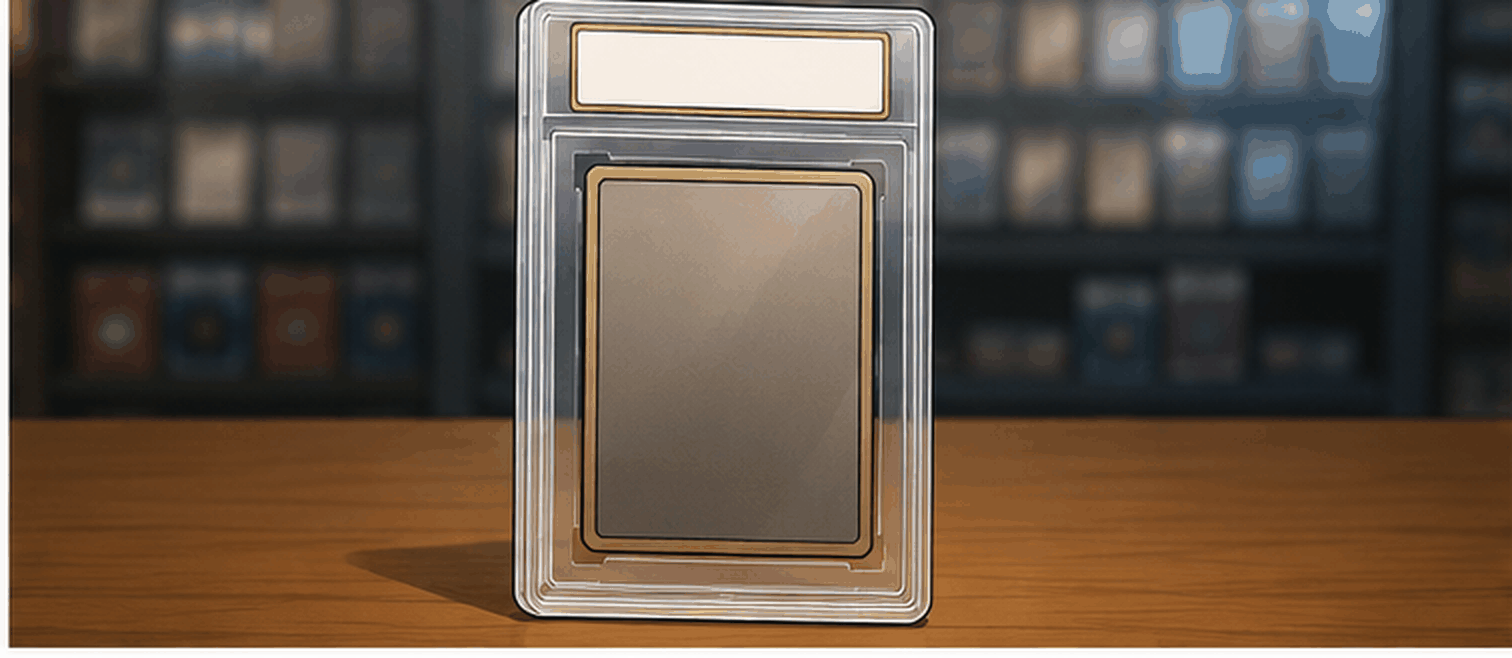
A slab is a claim about a card. It is not automatically proof.
In January 2026, a federal jury in Manhattan convicted a Washington man of conspiracy to commit wire fraud and wire fraud. Prosecutors said he took ungraded or lower-graded cards, removed the original grades and serial numbers, printed counterfeit labels showing grades of nine or ten with fabricated certification numbers, and sold the results as high-grade sports and Pokémon cards. Buyers lost more than two million dollars.
The practical lesson takes thirty seconds. Every major grading company maintains a public certification lookup. Type the number on the label into the grader’s own website and confirm the record matches the card in front of you: same card, same set, same grade. A mismatch, or a number that returns nothing, ends the conversation.
Examine the holder too. Look at the label print quality and font, and check whether the case shows signs of having been opened and resealed, such as seam irregularities or adhesive residue.
Sealed product has its own version of this. Resealed packs and boxes exist. Check that wrapping is factory tight rather than loose, look for creasing along the seams, and weigh the price against reality. Nobody sells genuine sealed vintage product well under market by accident.
If You Have Magic Cards
Magic uses different construction, so some Pokémon tests do not transfer directly. Magic cards have their own blue core layer and the light behavior differs.
The most cited check is the small green dot on the back of modern cards, which fakes often reproduce at the wrong size, shade, or position. Under magnification, genuine Magic printing shows a consistent rosette dot pattern that counterfeits commonly miss or reproduce as a flat solid.
Beyond that the fundamentals carry over: card stock feel, cut quality, font crispness, and back colour compared against a card you know is genuine.
If You Have One Piece Cards
The most consistently reported tell on One Piece counterfeits is the card back running purple or muddy rather than the correct balanced tone. It needs no equipment beyond a genuine card to compare against.
Fakes also tend to run noticeably thicker than genuine cards, which shows up fast in a stack. Check small text for fuzziness and colour for oversaturation or flatness.
The counterfeit targets are the money cards: alternate arts, manga rares, and high-rarity SR and SEC cards. Scale your scrutiny to the price.
If You Have Lorcana Cards
Cut quality is the first check most collectors reach for on Lorcana. Counterfeits frequently show uneven or jagged edges where genuine cards are cleanly and squarely cut.
Dimensions are standard at the usual trading card size, so a card that measures off is a straightforward flag. Print quality, colour depth, and small-text sharpness follow the same logic as every other game here.
Counterfeit effort concentrates on Enchanted variants, for the obvious reason that common Lorcana cards are worth cents while high-end Enchanted cards have sold for enormous sums. A suspicious common is unusual. A suspicious Enchanted deserves every check in this article.
What Each Check Actually Buys You
| Check | What it catches | What it misses | Gear needed |
|---|---|---|---|
| Price sanity | Most fakes, before you spend anything | A patient seller pricing at market | Sold-price lookup |
| Listing photos | Sellers who cannot show the card | A fake photographed well | Nothing |
| Feel and stock | Papery and plasticky fakes | Higher-quality counterfeits | A known-real card |
| Card back colour | Bad print jobs, most cheap fakes | Fakes with accurate colour | A known-real card |
| Font and spelling | Lazy fakes, most bulk counterfeits | Careful reproductions | Good light |
| Texture and holo | Printed-on fake texture | Non-textured card types | A light source |
| Light test | Thin-stock fakes with no dark core | Altered real cards, slabs, sealed | A lamp or phone |
| Cert number lookup | Fabricated or mismatched labels | An untouched genuine slab you doubt anyway | The grader’s website |
What to Do If You Think You Already Bought a Fake
First, slow down. Getting caught here is common and it is not a reflection on you. Counterfeits are designed to fool people who are not experts, which is nearly everyone.
Photograph it now, front, back, and edges, in good natural light, next to a card you know is genuine if you have one. Do this before anything else, because every following step depends on documentation.
Do nothing destructive. No rip test, no cleaning, no removing it from a holder. If there is a dispute, you will need it in the condition it arrived.
Contact the seller before escalating. The seller may have been fooled themselves and may be willing to resolve it directly. Give them that chance in writing, calmly, with your photos attached.
Check the platform’s buyer protection. Most major marketplaces have some form of it, but coverage, deadlines, and requirements vary a great deal between platforms and even between individual listings, and some windows are very short. Find your specific platform’s terms and the specific listing’s return policy, and note the deadline before you spend days going back and forth with a seller.
Do not resell it. Passing a suspected fake along, even honestly disclosed, is how counterfeits stay in circulation. Set it aside.
When to Put It in Someone Else’s Hands
There is a point where checking things yourself stops helping.
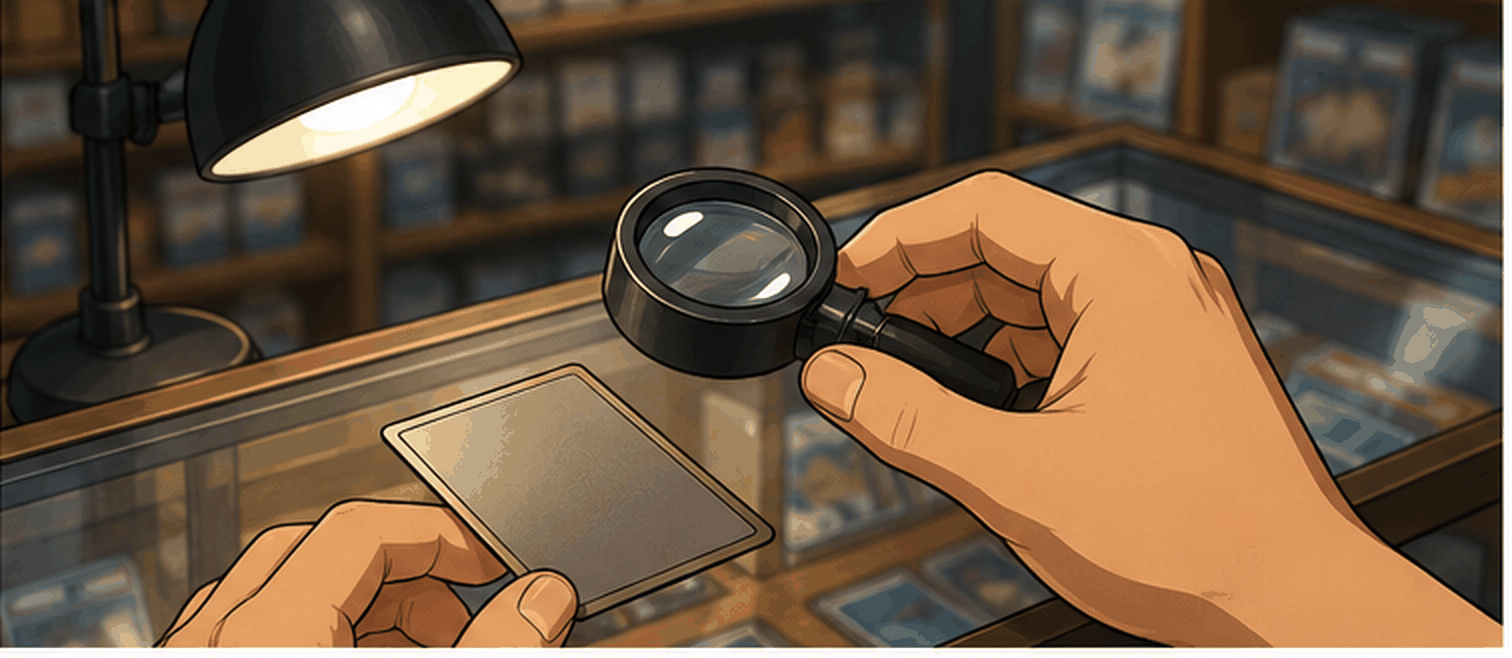
Some of what is in this article needs equipment you may not own, like a loupe. Some of it needs a genuine copy of the same card for comparison, which you probably do not have if that card is the reason you are reading this. And some of it is not really a test at all but pattern recognition, the kind that comes from handling thousands of cards and noticing when one is off before you can explain why.
Someone who buys and sells cards for a living has all three. TCGplayer’s own guidance on counterfeits points buyers toward local game stores for this reason, noting that some stores specializing in trading cards can review a card and offer an opinion on whether it is counterfeit.
Practically: call ahead, describe what you have, and ask whether they will take a look and what they charge, if anything. Policies differ from shop to shop, so ask rather than assume. Bring the card in a sleeve, your photos, and the listing if you bought it online.
You can find card and comic shops near you in the CollectorsHaul directory, including what each one specializes in. A store built around modern Pokémon is a better stop for a modern chase card than a shop that mostly handles vintage sports.
Frequently Asked Questions
How can you tell if a Pokémon card is fake?
Compare it against a card you know is genuine. Check the back for washed-out or purple colour, feel the card stock for papery or slick texture, look for spelling errors and a missing accent on the é in Pokémon, examine energy symbols for misalignment, and hold it to a light to check for the dark inner layer. Before you buy, the strongest signal is a price well below what the card actually sells for.
Does the light test always work?
No. It reliably catches cards printed on thin stock without the dark inner layer, which is most cheap counterfeits. It tells you nothing about a real card that has been altered or misrepresented, and it cannot be used on sealed product or on a card inside a graded holder. Use it alongside other checks, not instead of them.
Are fake Pokémon cards illegal to own?
Owning one is not the issue. Knowingly selling counterfeit cards or using forged authentication to deceive buyers can violate the law and has resulted in federal prosecution. If you discover you own one, set it aside rather than reselling it.
Can a fake card be graded by PSA or CGC?
Grading companies work to prevent it, but the label itself has been the target of fraud, including a 2026 federal conviction involving counterfeit grading labels with fabricated certification numbers. Always verify the certification number in the grading company’s own online lookup and confirm the record matches the card in front of you.
Why do fake cards feel different?
Genuine cards are built from layered stock with a specific stiffness and a lightly textured back. Counterfeits use cheaper materials, so they usually end up either too flimsy and papery or too slick and plasticky, and they often lack real physical texture on cards that should have it.
Is it safer to buy from a local card shop than online?
Buying in person lets you inspect the card before paying and gives you a person to go back to, which online buying from an unknown seller does not. It is not a guarantee, and plenty of online sellers are reputable, but it removes the specific risk of committing money based only on photos.
Before You Spend the Money
Most counterfeits give themselves away, and the checks that catch them are not difficult. Know what the card actually sells for. Insist on real photographs. Keep a card you know is genuine within reach to compare against. And treat any single test, including the light test, as one piece of evidence rather than a verdict.
When the checks come back inconclusive and there is real money on the line, the fastest path is a set of experienced hands. Find a card or comic shop near you and ask before you buy, not after.
If you are working through a whole collection rather than a single card, our guide on how to prepare your collection before visiting a card shop covers how to get it sorted and ready first.
← Back to Blog